Bright Real Estate

This project aimed to improve a real estate landing page that was underperforming in generating user inquiries and property sales.

This project aimed to improve a real estate landing page that was underperforming in generating user inquiries and property sales.

This project aimed to improve a real estate landing page that was underperforming in generating user inquiries and property sales.

This project aimed to improve a real estate landing page that was underperforming in generating user inquiries and property sales.

About
Bright Real Estate

About
Bright Real Estate

About
Bright Real Estate

About
Bright Real Estate

About
Bright Real Estate

Bright Real Estate collaborates with multiple builders to design and promote property listings through dedicated landing pages. For each new project, a landing page is created to drive user inquiries and sales.

Bright Real Estate collaborates with multiple builders to design and promote property listings through dedicated landing pages. For each new project, a landing page is created to drive user inquiries and sales.

Overview

My Role

  • Contributed to user research (surveys & interviews) and insight synthesis

  • Co-led ideation and validation of design directions

  • Led UI design and executed the landing page redesign

  • Collaborated with team on final testing

My Team

Team - Ashish, Sumit, Sagar (Amit - Manager)

Team - Ashish, Sumit, Sagar (Amit - Manager)

Research

How I started

How I started

How I started

To understand the problem better,

  • Reviewed competitor and builder landing pages

  • Collected feedback from potential buyers interacting with the landing page through interviews and surveys Analyzed behavioral data from Wix analytics of existing landing page

To understand the problem better,

  • Reviewed competitor and builder landing pages

  • Collected feedback from potential buyers interacting with the landing page through interviews and surveys Analyzed behavioral data from Wix analytics of existing landing page

Problem Identification

Validated through user feedback and analytics

Pain Points

Pain Points

Pain Points

  • 80% bounce rate, with most users leaving within seconds

  • ~5% inquiry rate, indicating low conversion from visits to leads

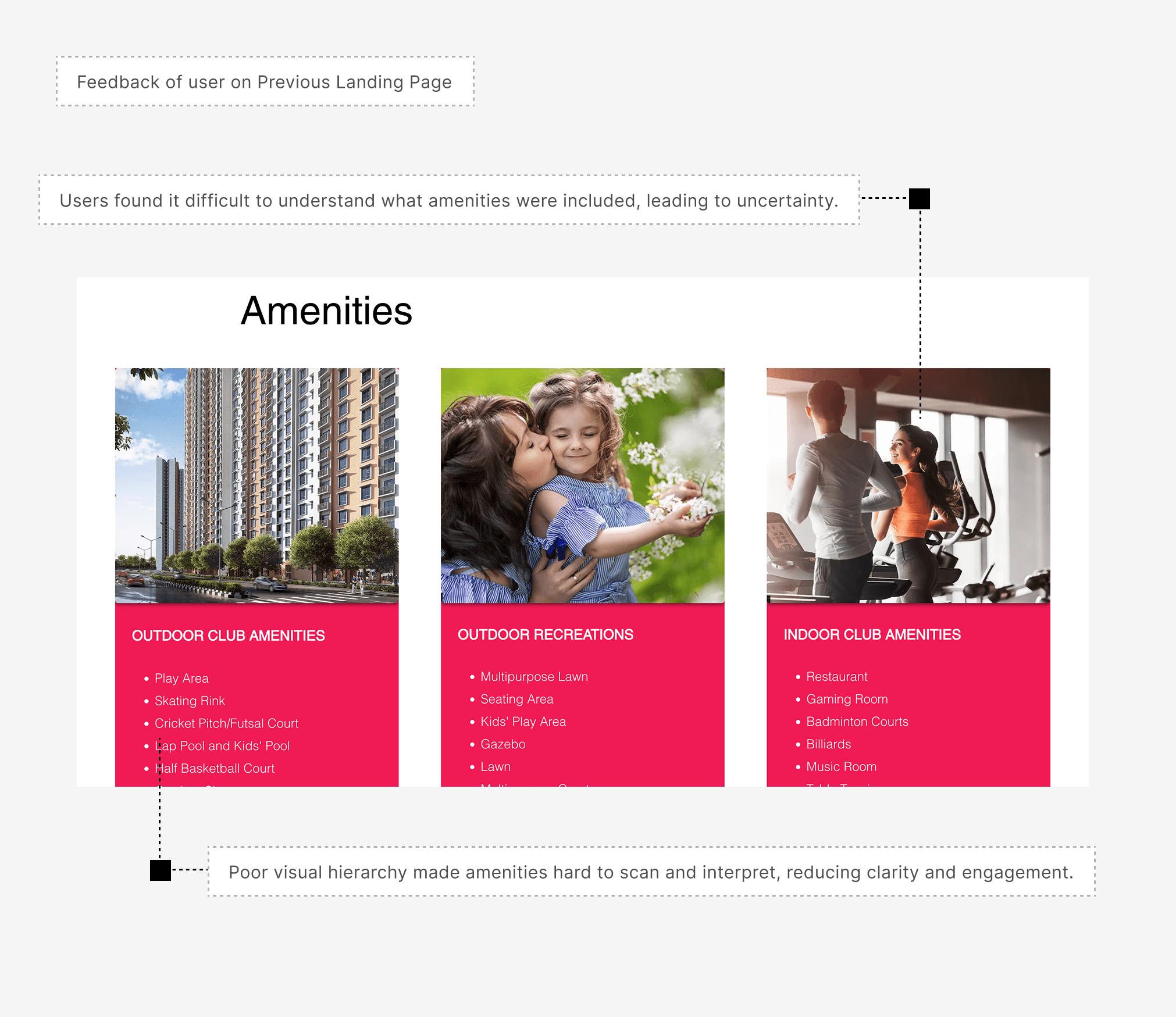
  • A weak visual hierarchy reduced scanning clarity and overall readability

  • A lack of early trust signals reduced user confidence in submitting inquiries

  • 80% bounce rate, with most users leaving within seconds

  • ~5% inquiry rate, indicating low conversion from visits to leads

  • A weak visual hierarchy reduced scanning clarity and overall readability

  • A lack of early trust signals reduced user confidence in submitting inquiries

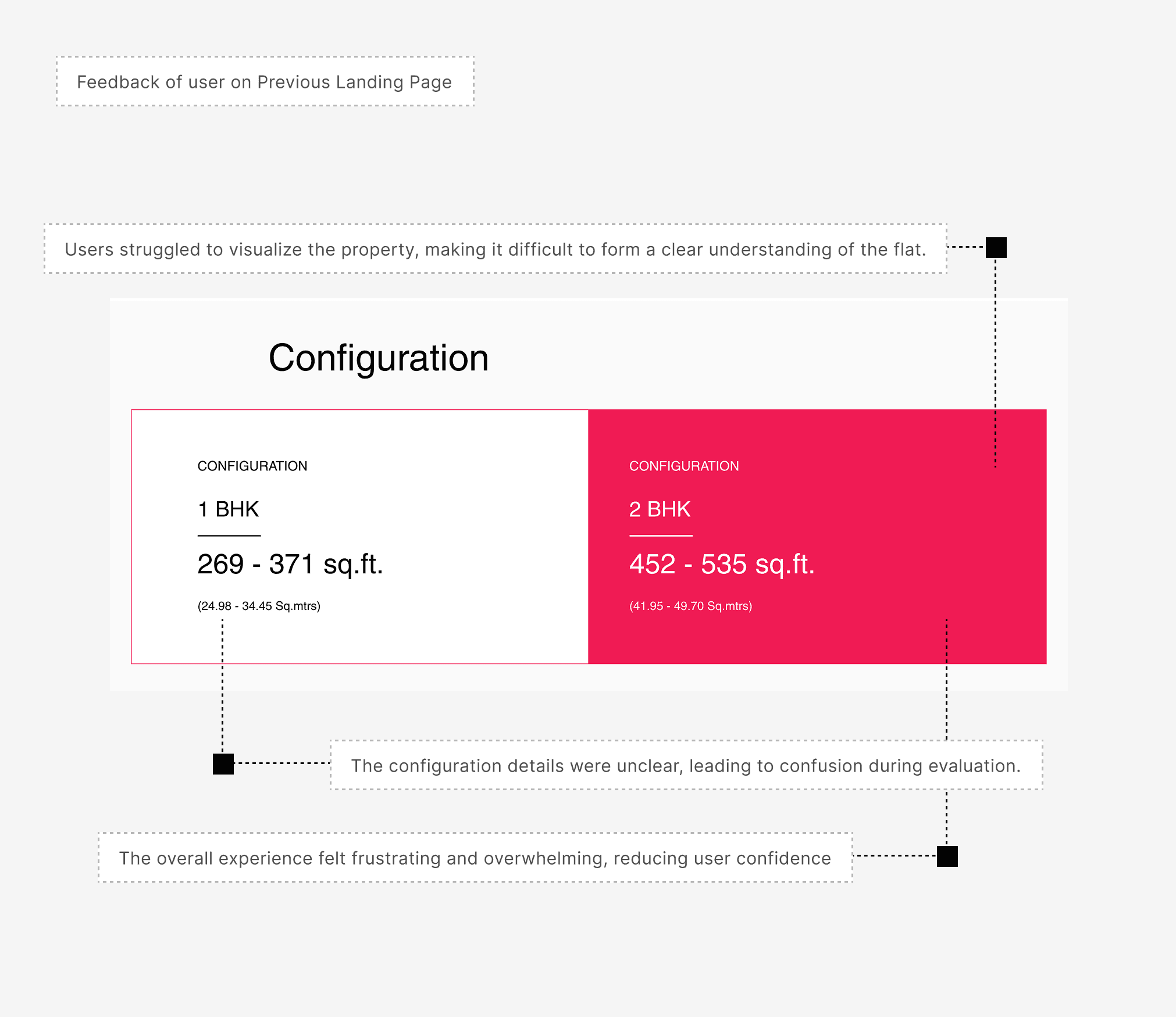
"The page didn’t clearly explain the project."

"Too much text made it hard to visualize the property."

"I wasn’t confident enough to submit an inquiry."

"The page didn't clearly deliver the information."

Research Overview

0
1
2
3
4
5
6
7
8
9

+

Users Interviewed

Collected live feedback from potential buyers visiting the landing page

Collected live feedback from potential buyers visiting the landing page

0
1
2
3
4
5
6
7
8
9

+

Competitor Analysis


Studied builder and real estate landing pages to identify best practices

Studied builder and real estate landing pages to identify best practices

Studied builder and real estate landing pages to identify best practices

0
1
2
3
4
5
6
7
8
9

+

Analytics Review

Used Wix Analytics to evaluate conversion and bounce rates.

Used Wix Analytics to evaluate conversion and bounce rates.

0
1
2
3
4
5
6
7
8
9

+

Timeline

The timeline for this product delivery was 3 weeks

The timeline for this product delivery was 3 weeks

Insight

Behavioural Analysis

  • Early drop-off behavior: ~80% of users left within seconds, with minimal scroll engagement below the fold

  • Low interaction with CTAs: Despite visibility, users were not engaging with inquiry actions

Interview Insight

  • Comprehension-first behavior: Users often skipped large text sections and relied on images to quickly judge property value.

  • Trust-dependent decision-making: Lack of immediate credibility signals reduced willingness to submit inquiries

Competitive Benchmarking

  • Visual-first hero sections: That could immediately communicate the property

  • Minimal above-the-fold text: To improve clarity and reduce cognitive load

Trade off & Constraints

Based on Research insight

Trade off

Trade off

Trade off

  • Visual clarity vs detailed information

 While users preferred a visual-first experience, completely removing detailed content wasn’t feasible. Information was restructured into scannable sections, balancing clarity with completeness.

  • Speed vs experimentation

 Due to time constraints, decisions relied on research insights and competitor patterns rather than testing multiple variations.

  • Simplicity vs expansion

 The focus remained on improving the existing experience instead of adding new features, avoiding unnecessary complexity within the scope.

Constraint

  • Limited access to users during redesign

 User feedback was gathered early in the process, but there was no opportunity to validate design decisions with users during or after implementation.

  • Campaign dependency

 Traffic was driven by ongoing campaigns, so audience intent and quality could not be controlled during the redesign phase.

Project goal
What we aimed for…

What we aimed for…

What we aimed for…

The goal of this project was to visually enhance the landing page by improving visual clarity, reducing cognitive load, and increasing user confidence—ultimately driving more inquiries and property sales.

The goal of this project was to visually enhance the landing page by improving visual clarity, reducing cognitive load, and increasing user confidence—ultimately driving more inquiries and property sales.

Design Insight

User Insight

Users struggled to quickly understand the property due to text-heavy content and weak visual hierarchy. In a high-investment, trust-driven decision context like real estate, users require immediate visual understanding and early credibility signals to feel confident enough to take action.

The strategy we followed

UX Strategy

UX Strategy

UX Strategy

  • See before you read → enable instant visual understanding

  • Trust before action → establish credibility early

  • Reduce cognitive load → simplify and structure content

  • Guide decisions → create a logical information flow

Solution

Following the research, the solution focused on

improving clarity, visual engagement, and user confidence.

My experience in the world of design across various industry

Following the research, here how I shaped the further solution.

Landing Page

Landing Page

Landing Page

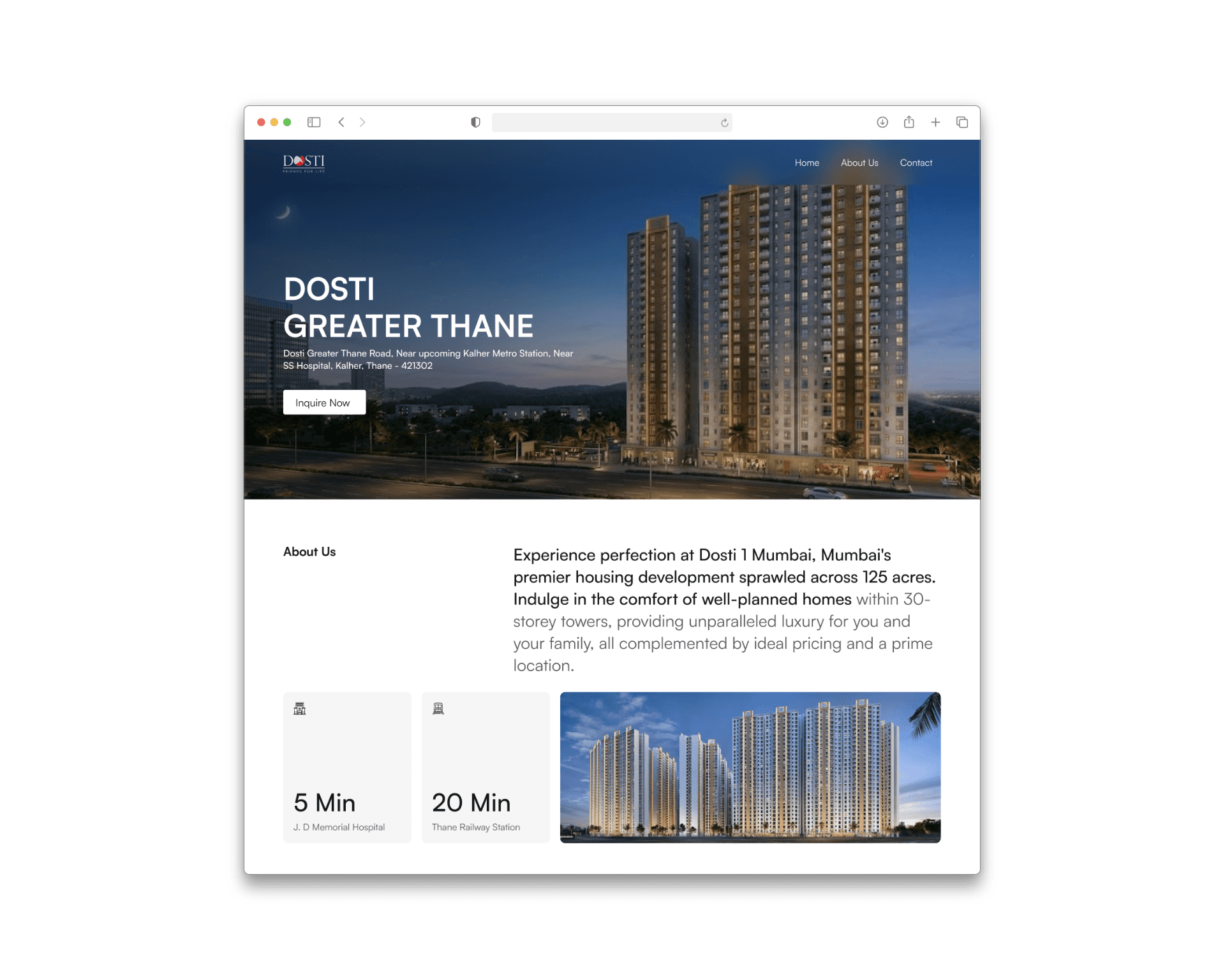
The landing page was redesigned with a visual-first approach, prioritizing property imagery in the hero section to enable immediate understanding.
Text-heavy sections were reduced and reorganized into scannable blocks with clear headings and key highlights.
Important details such as connectivity, location, and property features were surfaced earlier in the layout.
The inquiry flow was simplified by reducing form friction and making call-to-action elements more prominent and accessible for users.

Impact

Based on the final analysis.

Business Impact

Business Impact

Business Impact

  • Redesign became a template for future campaigns

  • Improved consistency across landing pages

  • Reduced dependency on content-heavy pages

Impact Context

To ensure accurate interpretation:


  • Analysis was conducted over comparable time periods (pre vs post launch)

  • Traffic came from the same campaign type, targeting similar audience segments

  • No major changes were made to pricing, offers, or property positioning

  • Conversion tracking (form submissions) remained consistent across both phase

Impact analysis

Analysis

Analysis

Analysis

We compared 4-week pre- and post-redesign performance using Wix Analytics, keeping campaign type and traffic sources consistent. Conversion (defined as form submissions) increased from 5% to 15%, alongside reduced bounce rate and improved engagement. While external factors cannot be fully ruled out, the improvements aligned with UX changes focused on visual clarity and trust signals.”

Outcome

0
1
2
3
4
5
6
7
8
9

Bounce Rate

The bounce rate was reduced from 80% to 45%

The bounce rate was reduced from 80% to 45%

0
1
2
3
4
5
6
7
8
9

Conversion Rate

Within first month the conversion rate increased from 5% to 15%.

Within first month the conversion rate increased from 5% to 15%.

Within first month the conversion rate increased from 5% to 15%.

0
1
2
3
4
5
6
7
8
9

Sales Growth

The landing page generated 42 leads

The landing page generated 42 leads

0
1
2
3
4
5
6
7
8
9

%

Lead to Sales

Out of 42 leads, 24 converted into purchases

Out of 42 leads, 24 converted into purchases

Take Away

Reflection

Reflection

Reflection

If I had more time, I would:

  • run A/B tests on hero variations

  • validate trust components through usability testing

  • analyze long-term lead quality beyond initial conversion

Let’s Work Together

Let’s Work Together

If you are building something meaningful, I’m all in.

If you are building something meaningful, I’m all in.

ashishshiv.upadhyay@gmail.com

Lets Connect

Lets Connect

Lets Connect